
 One of the most important yet misunderstood aspects of running an art business is pricing. For many artists, it feels like a guessing game—part emotion, part hope, and often, too much compromise. But pricing shouldn’t be arbitrary. It should reflect your time, training, materials, and the reality that you are a working professional. Artists deserve to make a living from their work, and that begins with a clear, consistent pricing structure that communicates value and builds trust.
Let’s begin with a foundational truth: your time is not free. If you want your creative practice to be sustainable, your pricing must account not only for materials and overhead but for your labor—designing, creating, finishing, marketing, and selling. Art is not a hobby when it pays your bills. It’s a career.
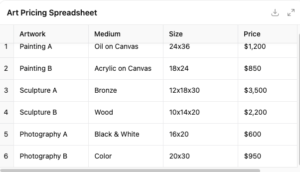
For 2D artists—painters, printmakers, illustrators—a square-inch pricing model is a useful place to start, but the multiplier should reflect your professionalism. Many mid-career artists price between $2.50 and $8.00 per square inch, while established artists often exceed $10. For example, a 16×20 painting at $6 per square inch would be $1,920. Add on framing and finish work, and the price might land at $2,100. That’s not just a number—it’s a reflection of experience, quality, and value.
3D artists—working in ceramics, sculpture, woodworking, fiber, or mixed media—should similarly develop pricing tiers based on size, complexity, and uniqueness. A small, hand-built ceramic sculpture that takes four hours to make, with high-quality materials and a specialty firing process, shouldn’t be priced at $75—it should be $250 or more. A large, labor-intensive wood piece could easily be $1,500 and up. These numbers aren’t inflated—they’re fair, especially when the process includes multiple days of carving, sanding, sealing, and finishing.
The key is to create structure. Your pricing should feel logical to your patrons and sustainable for you. That means similar works should be similarly priced—no wildly different prices for pieces of the same size or medium. If one 12×12 painting is $450 and another is $900 with no clear distinction, it creates confusion and damages credibility. However, if one involves intricate layering and fine detail while the other is a minimalist study, you can explain that. Transparency goes a long way in helping patrons understand what they’re investing in.
It’s also essential to consider the long-term arc of your business. Undervaluing your work now can make it harder to raise prices later. Consistent pricing across shows, online platforms, and galleries positions you as a professional. Patrons appreciate knowing they’re paying the same amount wherever they find your work. That consistency encourages repeat buyers, larger purchases, and word-of-mouth referrals.
Another consideration is market position. You are not competing with mass-produced décor or discount prints. You’re offering one-of-a-kind work created with care and intention. Your pricing should reflect that distinction. And while not every person will become a buyer, the right people will—especially when they sense your confidence and consistency.
Of course, pricing isn’t static. As your skill, demand, and costs increase, your prices should too. But even increases should follow a thoughtful structure. Review your pricing annually, adjust based on sales patterns, and raise prices incrementally and strategically.
Lastly, resist the temptation to price based on emotion—whether it’s imposter syndrome, fear of rejection, or the desire to make a quick sale. Pricing emotionally often leads to undercutting your own worth and the hard-earned efforts of your peers. You can still be generous, but generosity should be on your terms—whether it’s offering a payment plan or creating a “collector’s club” for repeat patrons, not discounting your value out of discomfort.
Artists are not just creators. You are business owners, entrepreneurs, and visionaries. You don’t need to justify your prices—you need to structure them. When you do, you empower yourself and educate your patrons to value not just what you make, but everything it takes to make it.
And that is how you make a living doing what you love.